
Recovering a commercial debt in Moldova should begin with evidence, an accurate calculation and the correct procedural route, not repeated calls or threats. A mistake before filing can weaken the case, while a favourable judgment by itself does not guarantee that the money will actually be collected.
B2B debt recovery in Moldova: the essentials
- Confirm the basis of the debt through the contract, orders, invoices, acceptance documents, correspondence and payments.
- A demand letter should contain a clear calculation and response deadline, not merely an urgent request to pay.
- Mediation is a separate voluntary settlement mechanism; it does not replace a review of the contract and evidence.
- A payment order, the small-claims procedure and ordinary litigation have different legal conditions.
- Before filing, assess both the chance of obtaining a judgment and the practical prospects of enforcement.
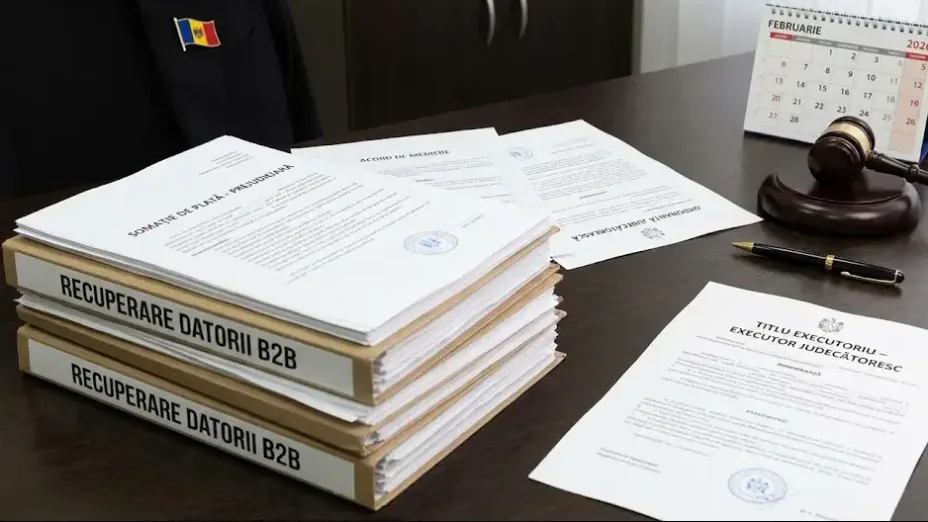
Start with an evidence file and a reliable calculation
It is not enough to say that the counterparty normally paid or acknowledged the problem by telephone. Reconstruct the entire obligation: who signed, what was delivered or performed, when payment became due and which objections the debtor raised. A working file normally includes the contract and appendices, purchase orders, invoices, delivery or acceptance documents, bank records, full correspondence and proof that the signatories had authority.
Separate principal from contractual penalties, interest and any other claim. Tie every component to a contract provision or legal basis and to a defined calculation period. If an acceptance document is missing, examine the contractual acceptance mechanism, any reasoned objections and the evidence that performance actually took place.
Preserve complete messages, transmission data and original documents. An isolated screenshot is weaker than the full conversation, delivery confirmation or payment record. A clear evidence map makes it easier to select the procedure and remove amounts that cannot be supported.
Demand letter, negotiation and mediation serve different purposes
A demand letter records the creditor's position: legal and contractual basis, amount, due date, payment details and the consequences of continued default. Check whether the contract or a special rule requires a pre-action step. Send the document in a way that proves both its content and delivery, and preserve the debtor's reply.
Negotiation is useful when it produces a verifiable result such as a written acknowledgement, payment schedule, security or signed settlement. A promise to pay next week should not postpone legal action indefinitely. A workable instalment agreement defines amounts, dates, consequences of further default and the treatment of accrued ancillary claims.
Mediation under Law No. 137/2015 is a structured and confidential process assisted by a mediator. It depends on the parties' consent and can help when both businesses want a solution but cannot agree on terms. It should not be described as automatically mandatory for every commercial dispute; the applicable law, contract and facts must be checked.
Need to review the documents and risks before the next step?
A lawyer can assess the contracts, correspondence and facts, identify vulnerable points and recommend a practical plan for the business.
How to choose the court procedure
The route is not selected merely because one option sounds faster. A payment order is available only where the statutory conditions are satisfied. Small claims are governed by a distinct chapter of the Code of Civil Procedure; the threshold is linked to the forecast average salary and must be checked at the filing date. Other disputes proceed as ordinary contentious claims.
If the debtor contests quality, scope, authority, set-off or delivery itself, the court may need a full examination of evidence. Before filing, identify the correct defendant, jurisdiction, claim value, court costs and every required exhibit. Do not combine proven amounts with speculative calculations.
Interim measures may matter where there is a concrete risk that assets will be transferred. They are not automatic: the requested measure must have a legal basis and be proportionate to the claim and the demonstrated risk.
A judgment is not the end of recovery
Once an enforceable document is available, a separate enforcement stage begins. Compulsory enforcement in Moldova is carried out by licensed bailiffs within their statutory powers. The creditor should submit the document in time, provide lawfully obtained information about the debtor and continue monitoring the file.
A lawful enforceability review is useful before litigation: confirm that the company still exists and trades, look for signs of restructuring or inability to pay, and check whether insolvency proceedings have started. A lack of publicly visible assets does not automatically make enforcement impossible, but it affects the budget and strategy. No specific seizure or restriction should be promised without checking the legal basis in the individual enforcement case.
Practical checklist for a creditor
- Record principal, due date and the currency of the obligation.
- Collect the contractual chain and evidence of actual performance.
- Check demand, jurisdiction, arbitration and mediation clauses.
- Send the calculation and demand through a provable channel.
- Do not extend negotiations without a written acknowledgement or workable schedule.
- Compare the available procedures against the documents and disputed facts.
- Assess insolvency indicators and enforcement prospects before major expenditure.
Limitation periods and their starting points depend on the type of claim and the events in the file. A universal formula should not be used without reviewing the contract, any acknowledgement or amendment of the debt and the applicable law.
When legal assistance is particularly important
A legal review matters for high-value claims, unsigned acceptance documents, counterclaims, foreign parties, arbitration clauses, asset transfers or signs of insolvency. Counsel should do more than draft a statement of claim: the evidence, procedural cost and realistic enforcement outcome should be considered together.
A practical strategy answers four questions: what can be proved, which amount should be claimed, which procedure fits and which assets might satisfy the judgment. That reduces the risk of spending time on a case that succeeds formally but produces no useful economic result.
Make the case file decision-ready before choosing a procedure
A useful debt file should let a lawyer, mediator or judge understand the transaction without reconstructing it from scattered messages. Put the signed contract and amendments, invoices, delivery or acceptance records, payment history and the complete correspondence in chronological order. Prepare a separate calculation showing principal, contractual interest, penalties and every partial payment.
Then verify the debtor's exact registered name, IDNO, address, current status and any known assets or pending insolvency. This determines whether negotiation, a payment order, an ordinary claim or an insolvency remedy is proportionate. Set a commercial objective as well: full recovery, an enforceable instalment plan, security, or a quick settlement. A documented objective prevents procedural costs from exceeding the amount that can realistically be collected.