
Practical guide to inheritance in Moldova: the notarial process, core documents, registration of inherited property, and common risks between heirs.
Inheritance in Moldova: key points and next steps
- Practical guide to inheritance in Moldova: the notarial process, core documents, registration of inherited property, and common risks between heirs.
- it is unclear whether a will exists;
- property documents have not been collected;
- several heirs have different expectations about shares;
Introduction
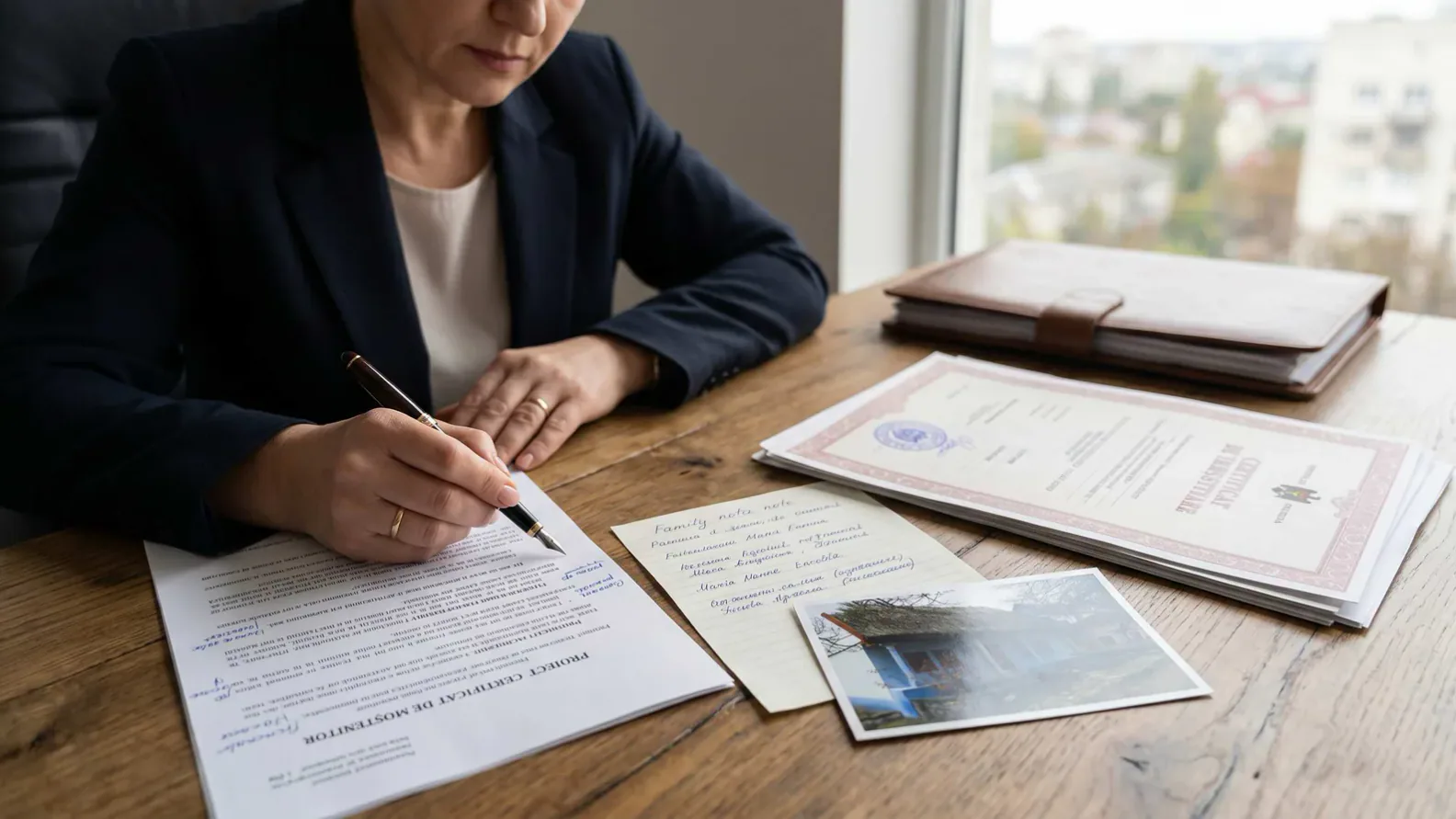
Inheritance issues in Moldova usually arise at a difficult moment for the family. That is exactly why people make practical mistakes: they postpone speaking with a notary, fail to collect property documents, do not verify whether a will exists, or assume that an apartment, house, land, or other assets will automatically pass to relatives without further legal action.
From a legal perspective, inheritance is not a single paper and not a single visit to a notary. It is a procedure that requires clarifying the circle of heirs, the composition of the estate, the existence of a will, the documents for each asset, possible rights of a surviving spouse, and sometimes debts or competing claims from other people.
This article explains what an inheritance matter in Moldova usually looks like in practice, which documents are commonly required, where the line runs between the notarial procedure and registration of property, and when an inheritance matter quickly turns into a dispute.
What inheritance means and why problems start early
Inheritance is not only an apartment or a house
When people talk about inheritance, they often think only about real estate. Legally, however, an inheritance matter may include much more: an apartment, a house, land, a vehicle, business interests, bank assets, property rights, and in some cases patrimonial obligations that cannot simply be ignored when assessing the full picture.
The common mistake: assuming everything resolves itself
Even if the family has no open conflict, that does not mean the legal side is already settled.
- it is unclear whether a will exists;
- property documents have not been collected;
- registry data is outdated;
- several heirs have different expectations about shares;
- some assets are not registered the way the family assumed;
- a representative, spouse, former spouse, or another person may have a legal interest that cannot be ignored.
Inheritance by law and inheritance by will
When the will matters
If the deceased left a will, it usually becomes the starting point for understanding who claims which assets. In practice, though, it is not enough to hear from relatives that a will existed. It is necessary to determine where it is, whether it was properly executed, and whether other relevant documents also affect the matter.
When inheritance by law applies
If there is no will, if the will does not cover all assets, or if other legal limitations arise, inheritance by law becomes relevant. In such cases, what matters most is who can document their right to participate in succession and how the rights of several people interact in the same file.
Where to start after a relative dies
First build a short legal map of the inheritance matter
- who died and what document confirms the death;
- who may qualify as an heir;
- whether a will exists;
- which assets are likely part of the estate;
- whether those assets are properly registered in the deceased person's name;
- whether some assets depend on separate registries or institutions;
- whether any person may challenge the future distribution.
Why it is important to verify the will and the wider circle of potential claimants early
Inheritance matters are often complicated not by a total lack of information, but by incomplete information. One heir may believe there is no will, another may have it at home, and someone else may think the disputed apartment belonged only to the deceased even though the legal position may be more complex.
Need a safe course of action for a family-law issue?
A lawyer can review the documents, people involved and applicable procedure, explain the main risks and prepare a clear sequence of next steps.
Which documents are usually needed
Core documents for starting the procedure
The exact set of documents depends on the assets involved and on the facts that must be proven. In practice, however, the following are almost always important: the death certificate, identity documents of the heir, documents proving kinship or another legal basis to inherit, information about the will, if one exists, and documents relating to the assets that likely form part of the estate.
Documents for real estate and other assets
According to the official ASP FAQ, registration of inherited immovable property usually requires the certificate of legal or testamentary heir, the applicant's identity document, the representative's identity document and proof of authority if a representative files the request, the geometric plan of the immovable property if it is missing from cadastral records, and proof of payment for services.
ASP also states that in particular cases the registrar may request additional documents with justification.
The role of the notary and registration of inherited property
The notarial procedure and registry registration are different stages
The notarial procedure formalizes the legal transfer of the estate, but certain assets still require registration in the relevant public registry. This is especially important for real estate and other assets whose practical use depends on registry records.
What ASP confirms for real estate
For the heir, the practical order is to identify the heirs and the legal basis of inheritance, complete the notarial succession stage, and separately complete registration of the specific property right where required.
Which risks should be checked before dividing assets
Several heirs and disputes over shares
The more heirs are involved, the higher the risk of conflict. One person may believe a disputed asset should go to them because they used it in practice, another may rely on the will, and a third may argue that the asset did not belong entirely to the deceased in the first place.
Spousal rights, debts, representation, and heirs abroad
- whether the asset belonged solely to the deceased or also affected a spouse's rights;
- whether obligations and debts must be assessed together with the assets;
- whether a representative has sufficient authority;
- whether some heirs are outside Moldova;
- whether some actions can be taken remotely without procedural risk.
If the estate includes an apartment, house, or land
Check not only ownership, but also the quality of registry data
If real estate is inherited, it is important to confirm not only that the deceased was the owner, but also whether the property documents are consistent and up to date. Problems often arise where technical or address data do not match, some cadastral data is missing, or the heirs started from an incomplete legal understanding of the property.
Do not confuse the heir certificate with final title registration
If the title must be reflected in a state registry, that stage still has to be completed separately. Otherwise, later problems may arise when selling, donating, partitioning, or using the property.
When an inheritance dispute goes beyond the notarial stage
Challenging the will, hidden heirs, and conflict over possession
Extra caution is needed if one heir disputes the existence or content of the will, a new claimant appears, part of the property is physically held by another relative, or the asset documents contradict each other.
When it is safer to involve a lawyer
Legal support is especially useful if the matter involves several heirs with conflicting interests, real estate with imperfect paperwork, a contested will, assets or participants outside Moldova, action through a power of attorney, or business interests and other complex property questions.
Practical checklist for an heir
- Obtain the document confirming death and gather personal documents.
- Verify whether a will exists.
- Identify everyone who may have heir status or another legal interest.
- Make a list of assets and documents for each asset.
- Review real estate separately if the estate includes it.
- Clarify where the notarial stage ends and where registry registration begins.
- Do not divide assets informally and do not sign disputed papers if a conflict already exists.
- In a complex matter, get an individual legal review before the dispute becomes harder to manage.
Conclusion
Inheritance in Moldova is not only a family matter, but also a full legal procedure. What matters is not only kinship, but also the documents, the composition of the estate, the existence of a will, the registry status of the assets, and the possible rights of other persons.
The safest approach is to build a legal map of the matter from the beginning: who inherits, what is inherited, which documents already exist, and where conflict may arise.