
A practical guide for buyers in Moldova: how the 150-euro threshold works now, what is expected from 1 October 2026, when VAT can be charged on a parcel and which documents should be kept.
Parcels under 150 euros: what to understand before ordering
The main question for buyers in Moldova is simple: will orders from Temu, Shein, AliExpress, Trendyol or another foreign platform become more expensive because of VAT? The short answer is that the current rule and the announced reform apply at different points in time.
- Until the rules change, parcels from foreign online stores worth up to 150 euros usually benefit from a favorable regime, but not for all goods and not in every situation.
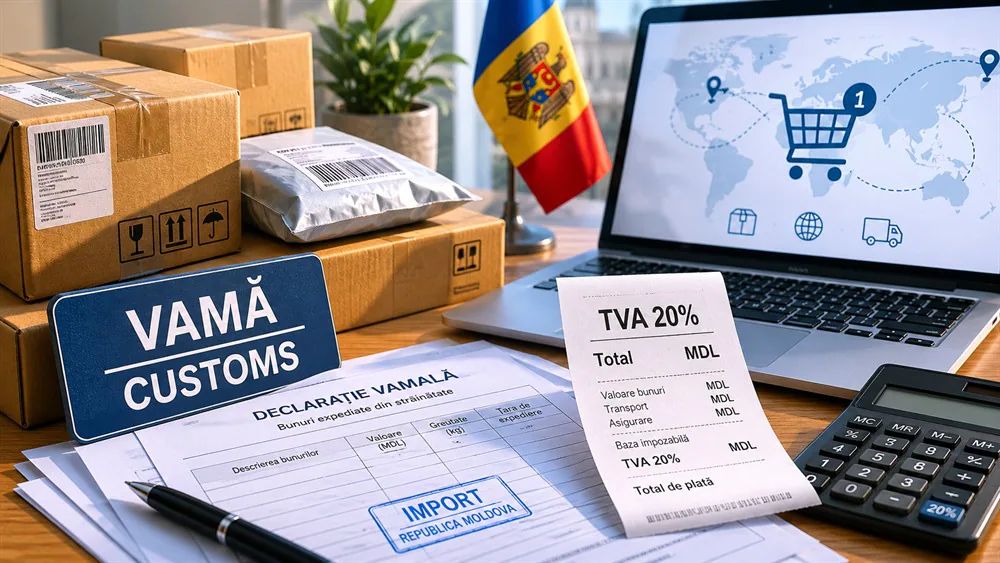
- From 1 October 2026, according to public statements by the authorities, standard 20% VAT is expected to apply to parcels worth less than 150 euros.
- Alcohol, tobacco, perfumes and consignments that do not look like occasional personal purchases can already fall outside the exemption.
- Buyers should keep the invoice, payment confirmation, order screenshot and correspondence with the seller: these documents help explain the price if the customs value is questioned.
- A marketplace label such as "including VAT" does not by itself prove that Moldovan import VAT has been paid.
This article is not about avoiding tax. The safer goal is to understand the final cost before ordering, avoid a blocked parcel and reduce the risk of a customs dispute after the goods arrive.
How the rule works now
According to Moldova's Customs Service, international postal consignments are subject to customs declaration and control unless the law provides an exception. For an ordinary buyer, three thresholds matter.
The first threshold is up to 150 euros. Goods in international postal consignments with an intrinsic value of up to 150 euros are usually declared verbally by being presented to the specialized customs post by the postal operator. For B2C orders, meaning goods sent by a foreign store or platform to an individual in Moldova, the Customs Service refers to an exemption for consignments up to 150 euros where the recipient is not acting as an entrepreneur in that operation.
The second threshold is from 150.01 to 1000 euros. These consignments are declared using the H6 reduced data set electronic customs declaration, either through a representative such as a broker or postal operator, or individually online through the public customs portal.
The third threshold is above 1000 euros. The standard H1 declaration applies and the procedure is handled through a representative.
There are important exceptions to the 150-euro exemption: alcohol products, tobacco and tobacco products, perfumes and eau de toilette, and consignments that are not occasional or personal in nature. These goods may be taxed regardless of value.
Legally, this means that a price below 150 euros is not absolute protection. If the contents, number of identical items, frequency of orders or intended use indicate a commercial character, the recipient may be asked for documents and import payments may be calculated.
What is expected to change from 1 October 2026
Moldova1 reported, citing the Minister of Finance, that from 1 October 2026 all parcels worth less than 150 euros will be subject to standard 20% VAT. In public explanations, this is presented as removing an existing exemption, not introducing a new tax.
The policy logic is clear: if the same product is sold in a Moldovan store with VAT, while a foreign order under 150 euros effectively arrives without VAT, this creates an issue of tax equality and competition. According to Ministry of Finance data cited by Moldova1, around 10 million parcels arrived in Moldova in 2025, with an estimated total value of about 10 billion lei.
For buyers, the practical effect is that a small order may become more expensive by the VAT amount. If a product costs 500 MDL, 20% VAT would roughly add 100 MDL if no other elements are included in the taxable base. The final price will depend on how the platform, seller, postal operator and customs authority process the specific transaction.
Until the final mechanism is published, details should be treated carefully. A simplified model is being discussed: VAT may be included directly in the platform price or paid when the parcel is collected. But platform-specific rules, transitional treatment for orders placed before 1 October and proof of payment should be checked against official instructions closer to launch.
Need to review the tax regime or your position before the STS?
A lawyer can assess the documents, calculations and applicable rules, separate confirmed obligations from disputable demands and recommend the next step.
How to estimate the final price
Buyers should look not only at the product price in the cart, but also at what is included in the final amount. After the new regime starts, several scenarios are possible.
First scenario: the marketplace includes Moldovan VAT in the checkout price. There may be a separate tax line or a general note that VAT is included. This is the most convenient option, but it requires transparency: the buyer should know which tax was withheld, for which country and for which transaction.
Second scenario: VAT is paid on parcel pickup or through the postal operator. In this case the product may look cheaper in the cart, but an additional amount appears at delivery. Buyers should factor this in before ordering.
Third scenario: customs or the operator asks for proof of value. This can happen if the price looks understated, documents are incomplete, the parcel contains several identical goods, or there are doubts about the purpose of the purchase. Useful documents include:
- invoice or order confirmation;
- bank statement or payment receipt;
- screenshots of the product page and cart;
- correspondence with the seller about a discount, return or replacement;
- tracking and delivery information.
Pay special attention to labels such as "including VAT". In May 2026, business media discussed a case where Trendyol displayed this label for Moldova users before the Moldovan rule was due to apply in October. Such wording may be part of the platform interface or reflect another jurisdiction's tax logic. What matters is confirmation that the tax is recognized for import into Moldova.
If the seller charges "tax", "VAT", "processing fee" or a similar amount, keep the payment page and final invoice. If VAT is requested again on pickup, documents will be needed to show what was already charged.
When a parcel becomes a legal problem
An ordinary order becomes a legal problem not because of VAT itself, but because the buyer, customs authority, operator or seller may evaluate the transaction differently.
The first risk is a dispute over value. If the goods were bought with a large discount, promo code or during a sale, customs may ask for proof of the real price. It is not enough to say "that was the website price"; documents must show what you actually paid and for what.
The second risk is commercial character. One phone case for personal use and twenty identical cases across several parcels look different. Even if each parcel is below 150 euros, repetition, quantity and the nature of the goods may raise questions. For entrepreneurs, buying goods, samples or components for business should not be disguised as a private purchase.
The third risk concerns restricted goods. Alcohol, tobacco, perfumes, certain medicines, currency values and prohibited or conditionally admitted goods require separate checks. In some cases the issue is not VAT, but permits, excise duties, postal restrictions or confiscation risk.
The fourth risk is returns. If after 1 October 2026 VAT is withheld by the marketplace or paid on pickup, buyers need to understand who refunds the tax, within what timeframe, based on which document and whether the refund is automatic. Until final instructions are available, check each platform's rules before expensive orders.
The fifth risk is double charging. If a platform withholds an amount as VAT and the operator requests another payment on delivery, ask for the calculation and legal basis. Sometimes it is practical to pay in order to receive the goods and then challenge the charge, but for expensive orders it is better to understand the calculation first.
Checklist before ordering and on pickup
Before ordering, check four things: the product price, delivery cost, whether there is a tax line in checkout, and the category of goods. If the goods are alcohol, tobacco, perfume, eau de toilette, or a quantity that looks like a commercial lot, do not rely on the usual 150-euro exemption.
If the order is placed before 1 October 2026, consider not only the payment date, but also arrival and customs clearance dates. Transitional rules should be verified in official instructions.
When receiving the parcel:
- Compare the calculated payments with the order documents.
- Ask for the calculation if the amount is unexpected.
- Keep operator notifications, payment receipt and release documents.
- Do not sign explanations or statements you do not understand.
- If the goods are held, clarify what is missing: invoice, payment proof, permit, declaration or explanation of intended use.
For entrepreneurs, the safer approach is stricter: if the goods are needed for business, treat the purchase as a commercial operation from the beginning. This reduces the risk of disputes over purpose, accounting and later tax questions.
Short conclusion for buyers in Moldova
VAT on parcels under 150 euros is not just a Temu or Shein story. It changes the usual online shopping model: small cross-border orders are gradually moving closer to normal consumption taxation in Moldova. Until 1 October 2026, current rules should be used carefully; after that date, buyers should check where VAT was withheld and which documents prove payment. If a parcel is held, the value is disputed or the purchase is connected with business, legal advice may save more than the tax itself.