
Since 14 February 2026, Moldova has Article 169¹ of the Criminal Code on acts of persecution. Signs of stalking, online evidence, sanctions and practical steps.
Online harassment in Moldova: what changed on 14 February 2026
- Moldova now has a specific criminal provision on acts of persecution: Article 169¹ of the Criminal Code.
- The provision covers not only physical following, but also actions through information technologies and electronic communication networks.
- A criminal case requires more than an unpleasant message: the conduct must be systematic, cause anxiety or fear and force the person to change their usual way of life.
- The basic offence may lead to a fine, community service or imprisonment for up to 2 years; if committed against a family member, the sanction is stricter.
Law No. 252/2025 supplemented the Criminal Code of the Republic of Moldova with Article 169¹, "Acts of persecution". According to ANPCV, the new provisions entered into force on 14 February 2026. This matters for situations that were often treated as a "private conflict", "persistence" or "just messages", even though they could seriously undermine a person's sense of safety.
The practical point is straightforward: if someone repeatedly follows you online, tries to contact you after a clear refusal, monitors places you visit or uses third parties to pressure you, you do not have to wait for a physical attack. But the opposite is also true: not every argument in a messenger automatically becomes a criminal case.
When persistent conduct becomes persecution
Article 169¹ is built around several elements. The conduct must be systematic, not accidental or isolated. It must cause anxiety or fear for the person's own safety or the safety of close relatives. It must also force the person to change their way of life.
In practice, this may mean changing the route home, closing accounts, avoiding usual places, asking friends not to publish location data, changing a phone number or constantly fearing calls. These changes should be linked to repeated actions by another person, not just general discomfort.
A single rude message, an unpleasant comment or a dispute after a breakup is usually not enough. Such episodes may form part of the broader picture, but Article 169¹ requires repetition and consequences. That is why chronology matters: when the conduct started, how often it repeated, what happened and how it affected the victim's behaviour.
If messages contain threats, sexual pressure, blackmail, illegal access to accounts or publication of intimate images, the situation may go beyond Article 169¹. Authorities or counsel should then assess the full set of possible violations.
What online actions may fall under Article 169¹
The law expressly refers to following a person, including through information technologies or electronic communication networks, monitoring the person's home, workplace or other frequently visited places, and contacting or attempting to contact the person by any means or through another person.
In the digital environment, this may include repeated messages after a clear refusal, calls from different numbers, new accounts after being blocked, attempts to reach the person through friends, colleagues or relatives, monitoring posts and locations, intrusive comments or appearing in work chats or customer channels to pressure a specific person.
The risk increases when online behaviour is combined with offline tracking. For example, someone writes that they know where the victim is, appears near their home or workplace, comments on routes or sends photos of the building, car or office. Such details may intensify fear and show that the situation is not merely an online conversation.
Article 169¹ does not require the perpetrator to be a stranger. Often it may be a former partner, relative, colleague, customer, person from the same social circle or someone involved in a conflict. If the conduct is committed against a family member, the sanction may be a fine of 600-1000 conventional units, 180-240 hours of community service or imprisonment for up to 3 years.
Need protection after an offence or stalking?
A lawyer can help preserve evidence, clarify your procedural status and choose a lawful next step that reflects the urgency of the situation.
What evidence to preserve before reporting
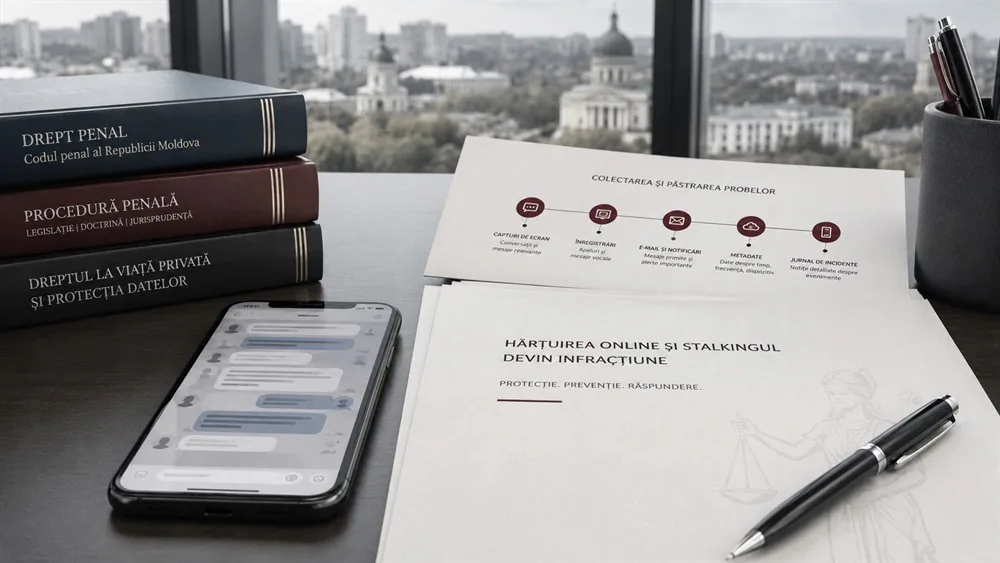
In online harassment cases, evidence is often in phones, accounts and chats. It should be preserved quickly, before messages are deleted, accounts are blocked or links disappear.
A useful minimum includes:
- screenshots of messages, comments, calls and profiles with date and time;
- links to accounts, posts, chats or pages, if available;
- an incident log: date, time, what happened, through which channel and who could see it;
- records of blocks, platform reports and messages to group administrators or employers;
- witness details if messages came through third parties or the conduct was public;
- proof of changed behaviour: changed phone number, route, work settings, account restrictions or support requests.
Do not edit screenshots, cut out context so the date disappears or keep only isolated images without the original conversation. If possible, preserve originals: chat exports, URLs, emails with technical headers or call history.
Audio and video recordings require caution: admissibility and risks depend on the circumstances. If the situation is serious, discuss how to preserve evidence with a lawyer.
What the victim can do and what to avoid
If there is an immediate threat to life, health or safety, call 112 first. Legal analysis is important, but it does not replace emergency help.
If immediate intervention is not required, act in order. Preserve evidence and chronology. Limit the perpetrator's access to information: review account privacy, disable public geotags and ask close contacts not to share your location. Then consider contacting the police, a lawyer or specialised support services.
ANPCV lists several support resources: 112, the Trust Line for Women and Girls 0 8008 8008, the Child Helpline 116 111, eviolenta.md, 12plus.md and siguronline.md for digital violence cases.
It is better to avoid:
- long emotional exchanges if they fuel the harassment;
- publishing the alleged perpetrator's personal data;
- asking friends to intimidate the person;
- deleting conversations before preserving evidence;
- assuming that blocking always solves the problem, especially where multiple accounts, numbers or third parties are used.
Sometimes it is safer not to warn the perpetrator about a planned complaint, especially if escalation is possible. The right approach depends on the facts.
Why businesses and online communities should pay attention
Online harassment seems personal, but businesses encounter it more often than expected. It may involve an employee pursuing a colleague after rejection, a customer persistently messaging a manager's personal accounts, a former employee pressuring the team or a community member moving a comment dispute into private messages.
An employer or community administrator should not independently label the conduct as a crime. But they should have a clear response: receive the complaint, preserve available evidence, limit contact in work or public channels, avoid disclosing unnecessary victim data and avoid forcing the victim to "just talk" to the person they fear.
For HR, this is also a workplace safety and discipline issue. If the harassment occurs through work chats, corporate email, work phones or at the workplace, the company should not ignore it as a private conflict.
For online businesses and communities, simple moderation rules help: no persistent contact after refusal, no publication of personal data, a fast complaint channel, preservation of logs and consistent blocking of accounts used to pressure a specific person.
Short conclusion
Article 169¹ does not turn every unpleasant conversation into a criminal case. But it gives a legal tool for situations where repeated conduct causes fear and forces a person to change their life. If messages, tracking or contact attempts continue after refusal, document the chronology, preserve evidence and seek advice before the situation escalates.
Build an incident log another person can understand
For every incident record the date and time, channel, account or number, short description, the victim’s response and the preserved file. Export original messages, record URLs and profile details, and keep a backup away from the phone. Connected incidents should show the course of conduct and its effect on safety or daily life, not merely a folder of isolated screenshots.
Do not create a dangerous confrontation to obtain more evidence. If there is an immediate threat, seek emergency help first and complete the evidence file afterward.