
Nothing has changed in your apartment: the walls are still in place and there is no extension. Yet the data used to value it shows a different floor area or characteristic. Before disputing the amount, check which property the cadastre actually ‘sees’: a separate verification stage is now available.
New valuation: five actions for property owners
- Check the result now. On 28 September 2026, the Cadastre announced a 30-day period for checking property characteristics.
- Compare the data with your documents. Start with the cadastral number, floor area, designated use and property description.
- Identify a specific discrepancy. “The record shows 74 m²; the technical document shows 62 m²” is more useful than “the value is too high”.
- Keep the request and proof of submission. According to the Cadastre's explanation, owners are informed of the outcome within 30 days.
- Check the route for challenging a refusal. The response period and the deadline for a subsequent challenge are separate matters.
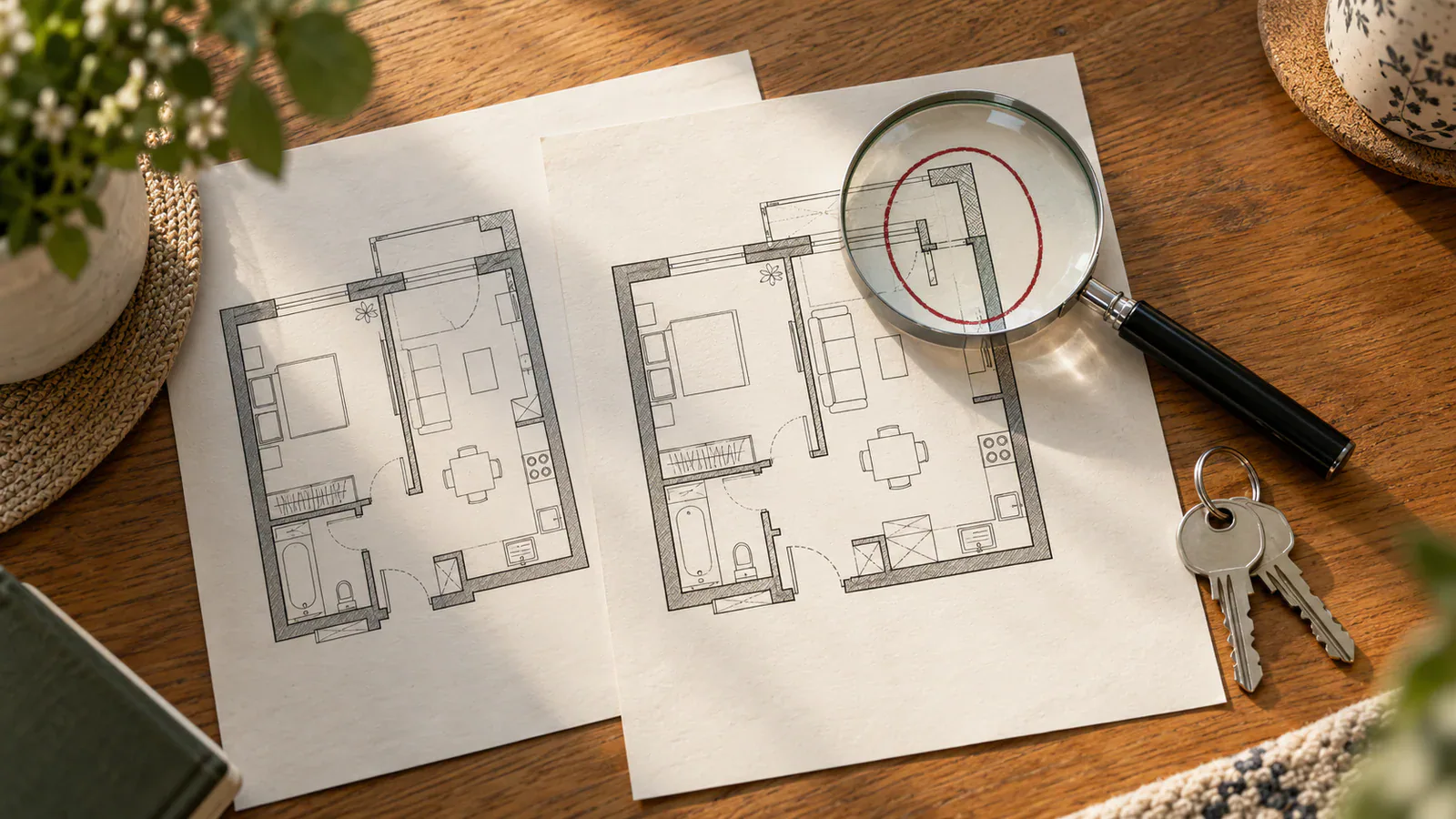
Why a new value does not automatically mean a new tax bill
A cadastral valuation for tax purposes is a calculated property value established under mass valuation rules. It is neither a seller's asking price nor the tax amount payable. Your first question should therefore be: “Which data was used in the calculation?”
On 28 September 2026, the Public Institution “Cadastre of Immovable Property” (IPCBI) published the valuation and revaluation results. Its official notice expressly states that publication online and in physical form constitutes official notification to owners. You should not wait for an individual letter before starting your check.
A value may rise even when the characteristics are correct. A calculation based on incorrect data requires a separate check. A high figure and a demonstrable error are different grounds for an enquiry.
When launching the programme, IPCBI announced that the new values were planned to apply from 1 January 2027. The eventual tax liability also depends on applicable rates and exemptions. You must not multiply the new value by a rate mentioned in news about a draft law and treat the result as your future tax bill.
Which details to compare: five places to look for discrepancies
Open the results on geodata.gov.md in the property valuation and revaluation section, or in the owner's personal account in EVO. Without internet access, you can consult the results at the territorial cadastral service or the local mayor's office.
Have your ownership document, a current register extract if available, and the cadastral or technical plan ready. If you previously submitted an objection, add its copy and the response. Check the details in order:
- Cadastral number and address. Are you looking at your property rather than another plot, premises or building? For a house, clarify which property each entry describes.
- Area. Compare the same measurements. Total floor area and living area are different by definition; different figures in different fields do not by themselves prove an error.
- Designated use and property type. Compare the record's description with the registered documents. A wrong category and a dispute over permitted use require different assessments.
- Characteristics used in the calculation. If the record shows them, check the floor, construction year, condition and other parameters against the documents. Do not assume every practical shortcoming automatically changes the valuation.
- Changes since the documents were prepared. An extension, reconstruction or actual increase in area may mean that the file is out of date. Under IPCBI's explanation, cadastral work and an update of the records may be needed.
Hypothetical example. Comparable documents show an apartment area of 62 m², while the valuation uses 74 m². First identify the source of both figures. If one is total area and the other is living area, simply asking to “remove 12 metres” is not enough. If both describe the same characteristic, request a check of that discrepancy and attach the supporting document.
Record what you find: save the property record with the date you consulted it and mark the relevant page in the document. This gives you the basis for a request that can be checked, rather than a reaction to a large amount.
Found a discrepancy in the cadastral data?
Colenco Legal will compare the property data with your documents, assess the Cadastre's response and help prepare a request or a position for challenging the decision.
How to write a request that can be checked
Ask for a specific characteristic and its source to be checked. The cadastral service needs to understand what you dispute, which evidence supports the discrepancy and which action you request.
In your account of the situation, include:
- your details and a contact for the response;
- the property's cadastral number and address;
- the disputed characteristic and the value used in the valuation;
- the value in the document, its title and date;
- a request to check the data, correct it if an error is confirmed, and recalculate the valuation if the correction affects the calculation;
- a list of attachments.
Illustrative wording, not an official form:
“The valuation of property with cadastral number […] uses an area of 74 m². The attached technical document dated […] shows an area in the same category of 62 m². Please check the source of the discrepancy, compare the data with the cadastral file and provide a reasoned outcome. If an error is confirmed, please correct the characteristic and, if this affects the calculation, recalculate the value.”
Do not refer to evidence you do not have. If a necessary document is missing, identify the data and source that need to be checked. In a dispute about property condition, photographs may supplement the explanation, but they do not establish the correct cadastral value on their own.
Under IPCBI's notice of 28 September, a request may be submitted through geodata.gov.md, by email, through Poșta Moldovei or in person at the territorial service. Check the format, signature and attachment requirements for your chosen channel. If acting for a relative, clarify the necessary evidence of authority.
Obtain and keep proof of receipt: a registration number, electronic acknowledgement or postal confirmation. A telephone conversation helps clarify matters but does not replace a documented request.
Check the service location before visiting. From 1 October, some cadastral services are provided at territorial services and others at ASP centres; Chișinău is listed among the ASP centres. The current AGCC list helps you choose where to obtain documents. Address the valuation request itself to the competent territorial cadastral service.
How to assess the response and distinguish the two periods
There are currently two separate periods of 30 days. The first is the check of published results announced by IPCBI from 28 September. The second is the period for informing you of the outcome of your request, running from submission. Do not calculate the second period from the first time you opened the property record.
Earlier notices on the preliminary valuation mentioned 90 days. Those concerned another stage. For action now, follow the new notification and applicable procedure rather than an old publication.
When the response arrives, check three points: which discrepancy was examined, which documents were used for comparison and how the conclusion is justified.
An error is confirmed. Under the official explanation, the characteristics are corrected and the value is recalculated where necessary. Check the updated data and keep the response. A correction does not automatically cancel tax previously assessed.
The data is considered correct. Clarify why you disagree. The dispute may concern the source of a characteristic, or the valuation model even though the data is accurate. Repeating “the neighbouring apartment is cheaper” does not identify an error: the properties may have different parameters.
There is no response, or it does not resolve the question you raised. Keep proof of submission and the correspondence. Choose the next step according to the request's content and the applicable procedure.
IPCBI indicates that a decision may be challenged through administrative court proceedings. Before going to court, check the procedure, competent court and time limit for the particular act. You should not assume that sending another letter automatically extends the deadline for protecting your rights.
When a lawyer can help: the dispute starts with documents
You can compare the property record with the plan and describe an obvious discrepancy yourself. Legal assessment is particularly useful if the Cadastre refuses the request, the documents conflict, several properties are affected, or the situation involves reconstruction, shares or co-owners' rights.
A dispute over the calculation method when the characteristics are correct requires separate assessment. If you have already received a tax notice, clarify what you are challenging: the property data, the valuation or the tax assessment. A single request may not resolve all of these matters.
For a consultation, collect the valuation record, ownership and characteristic documents, previous requests, responses and evidence of receiving them. These materials help identify the subject of the dispute and the next step. You do not need to write a long complaint first: preserving the original documents and chronology is more useful.
Start now with one property and one comparison. Link the discrepancy you find to a document, and a refusal you receive to its specific grounds and the available means of protection.