
A practical guide for online sellers in Moldova: when social media sales become a business, which registration route may fit, what documents are needed, and how to reduce tax and consumer-protection risks.
When online sales in Moldova start to look like a business
- A one-off sale of a personal item is usually not a business, but regular orders, advertising, stock and suppliers change the picture.
- A social network does not make the sale "private": if there is a commercial model, registration, taxes, documents and consumer rights matter.
- Receiving money on a personal card does not solve the legal issue. Regular incoming payments without a clear basis may raise questions from the bank, SFS or the buyer.
- The earlier the seller clarifies the model, the easier it is to scale: delivery, ads, suppliers, marketplaces and payments without constant legal risk.
In Moldova, many online sales start in the same way: a few products in Instagram Stories, orders in direct messages, payment to a card, delivery by courier or post. At first it may seem too small to be a "real business". The problem appears later, when sales become regular and there are suppliers, prepayments, returns, complaints, imported batches or a need to explain the source of money.
The legal question is not where the sale happened - Instagram, TikTok, Telegram, a website or a marketplace. The question is what the seller is actually doing: selling a personal item once or systematically offering goods to the market and earning income.
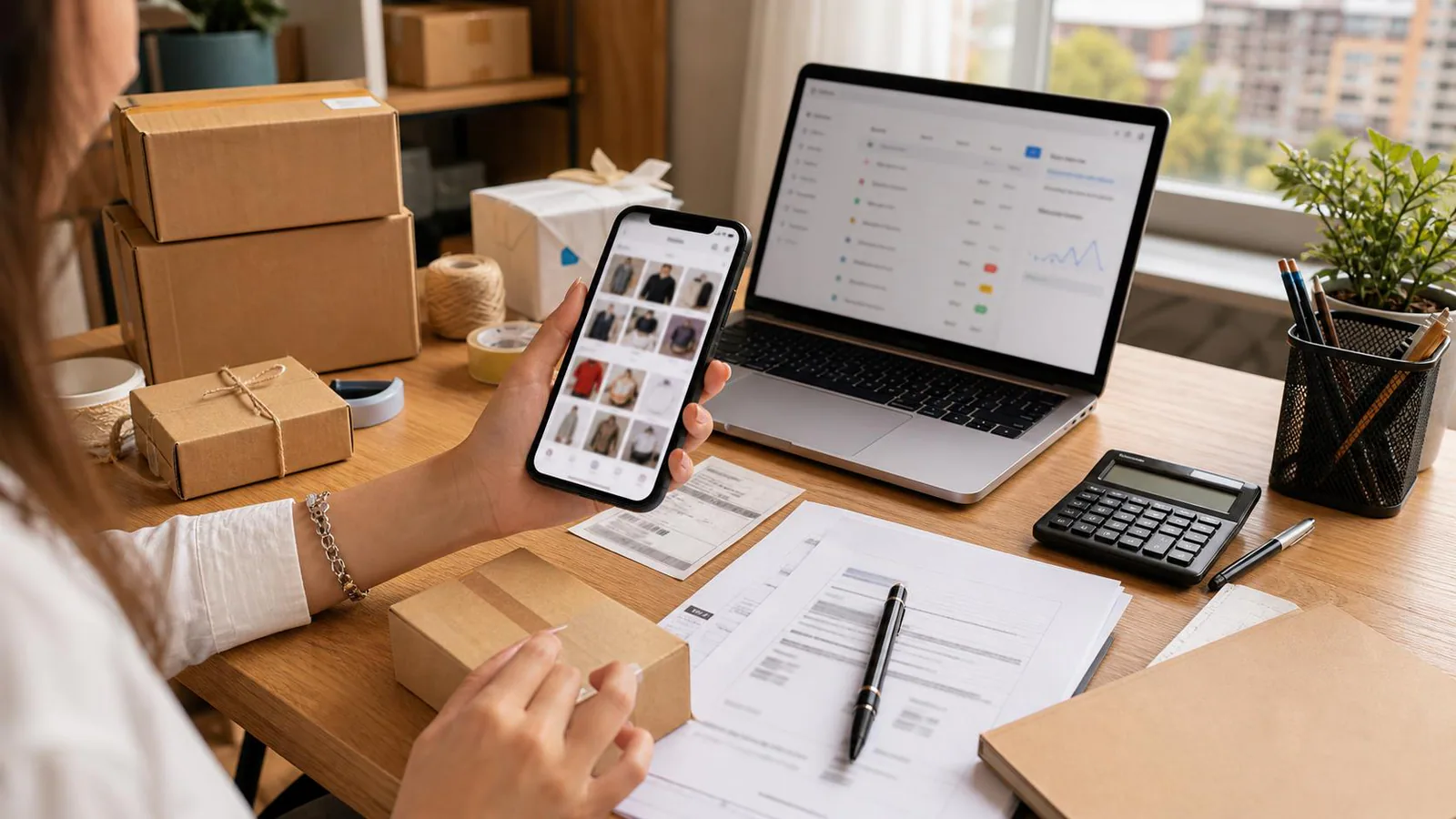
One-off sale, hobby or trade: where the practical line is
A one-off sale of a personal phone, stroller or furniture after moving looks different from commercial activity. There is no permanent range, advertising, purchases for resale, repeat orders or customer service.
Signs of a business appear when the activity becomes repeatable:
- you regularly post products and accept orders;
- you buy goods specifically for resale;
- you use ads, targeting, influencers or promo codes;
- you keep a price list, catalogue, highlights, website or shop page;
- you accept prepayments or card payments from different people;
- you promise delivery, exchange, warranty or return;
- you involve assistants, couriers, SMM specialists or order managers;
- you import goods not for personal use but for sale.
One sign alone does not always decide the issue. A person may sell several personal items in a month. But if purchases, regular advertising, similar products, customer chats and incoming payments from buyers all exist together, explaining it as "just personal sales" becomes weak.
The weakest position is when the business is already operating in fact but there are no documents: the supplier is not documented, the origin of goods is not confirmed, the buyer has no proof of purchase, return rules are not described and business money is mixed with personal spending.
Which form to choose before turnover grows
There is no universal form for every online seller. In Moldova the answer depends on the model: services or goods, turnover, risks, suppliers, import, employees, platforms and growth plans.
If a person provides services personally, the independent/freelancer route may sometimes be checked. ASP describes it as individual economic activity in the field of services, with online registration, assignment of IDNO and registration in state systems. But this route must not be automatically applied to any trade in goods. If you sell clothes, cosmetics, electronics or imported products, you need to separately check whether the chosen regime and activity codes fit.
An individual entrepreneur may be a logical option for a small business where the seller acts alone and wants to legalize trade without creating a company. Even then, the tax regime, accounting, documents, limits and possible property risks should be discussed with an accountant in advance.
An SRL is usually considered when the business grows: there are partners, employees, warehouse, imports, significant contracts, advertising, B2B clients, marketplaces, long-term obligations or risk of claims. A company helps separate business money from personal money and creates a clearer structure, but it also requires corporate, accounting and tax discipline.
Before registration, answer five questions:
- What is being sold: goods, services, a digital product or a mixed model?
- Where do the goods come from: personal items, local suppliers, imports, handmade, dropshipping?
- Who is the buyer: individuals, companies, foreign clients?
- How is payment accepted: card, cash, invoice, payment service, marketplace?
- Is scaling planned: advertising, employees, warehouse, website, partners?
These answers matter more than the wish to "keep it simple". A form that is too simple may not cover the real activity, while an overly complex one may create unnecessary costs at the start.
Selling through social media or marketplaces?
We review the sales model, registration route, customer documents and the main tax and consumer-protection risks.
Taxes and documents: what should be visible for each sale
Tax risk in online sales usually appears not because of one small payment, but because of repetition and lack of explainable documentation. If money regularly arrives from different people with descriptions such as "for dress", "for cosmetics", "prepayment" or "delivery", the seller needs to understand which legal and tax regime stands behind these payments.
The minimum document logic is simple:
- it is clear where the goods came from or how they were purchased;
- it is clear who bought them and at what price;
- it is possible to explain why the money arrived on this account or card;
- there is proof of delivery or handover;
- the buyer can receive proof of purchase;
- personal expenses are not chaotically mixed with business turnover.
If the payment goes to a personal card, this does not make the income invisible or turn commercial activity into private activity. The bank may ask questions about regular incoming payments. The buyer may request proof of payment. The tax authority may examine the economic nature of the money. In a dispute, direct messages, payment screenshots and delivery history become evidence, but not always in the seller's favor.
Prepayments are a separate risk area. If the seller takes money in advance but delivery terms, refusal, return and exchange are not clearly set, any supplier failure can become a conflict with the buyer. The phrase "custom order, no returns" does not always help if the buyer did not receive clear information before payment or the product is nonconforming.
An accountant is useful not only for declarations. They help choose the regime, set up sales records, understand payment flows, decide what documents to keep, and account for imports, delivery, platform commissions and returns. A lawyer is needed where there is a sales model, public offer, consumer complaints, supplier disputes or a choice of business form.
Consumer rights also apply to social media sales
If the seller acts as a business, the buyer remains a consumer even if the order was placed through Instagram direct or TikTok messages. For the control authority, the actual sale to a consumer matters more than whether there is a traditional website.
For an online seller, four information blocks are critical:
- who the seller is and how to contact them;
- what exactly is sold: features, size, composition, condition, set;
- how much the product, delivery and extra payments cost;
- what the payment, delivery, exchange, return and complaint terms are.
ISSPNPC publishes checklists, including for electronic commerce and for general requirements on selling products and providing services. This is a clear signal for businesses: e-commerce is not a "grey zone", even if sales happen through social networks.
A buyer who believes that a product or service is nonconforming usually first addresses the seller and attaches a receipt or other proof of purchase. If the seller refuses or does not answer, the dispute may go to the consumer protection authority or court. For the seller, this means one practical thing: there should be a complaint-handling procedure, not replies such as "we return nothing".
It is useful to prepare short rules in advance:
- how the buyer places an order;
- when the order is confirmed;
- how prepayment is recorded;
- who pays for delivery;
- what happens if the product does not fit;
- how a complaint is submitted;
- when the seller responds;
- which products have special return or warranty terms.
These rules should not be copied from another online store. They should match your model, product and Moldovan law.
Mistakes that most often lead to disputes or inspections
The first mistake is thinking that "it is just Instagram". If the page looks like a shop, has stock, prices, ads, reviews, delivery and regular sales, it will be difficult to argue that there is no business activity.
The second mistake is accepting all money on a personal card and not separating personal expenses from turnover. At an early stage this seems convenient, but later it makes it harder to explain income, calculate profit, prove returns, work with suppliers and connect payment tools.
The third mistake is selling imported goods as if they were personal parcels. If goods are ordered regularly, in batches or for resale, customs, tax and document questions arise. Splitting purchases or registering goods under different people is especially risky if, in fact, it is one commercial scheme.
The fourth mistake is not having clear return and complaint rules. When a product does not fit, is delayed or has a defect, the seller starts improvising. Sharp messages, voice notes, deleted stories and promises appear in chats and later become hard to explain.
The fifth mistake is using other people's cards or accounts. Such a scheme may create problems not only for the seller but also for the person who formally receives the payments. If the activity is commercial, it is better to build a transparent payment route.
The sixth mistake is advertising without checking promises. Words such as "original", "certified", "heals", "100% guarantee", "returns impossible", "last day of discount" may have legal meaning. In a dispute, the buyer may rely not only on the agreement but also on stories, posts, chats, product descriptions and advertising promises.
What to do before launch or scaling
If sales are already regular, start not with a complex legal structure but with a short map of the business. Write down what you sell, where the goods come from, who buys, how you receive money, how you deliver, what documents exist, which complaints have already appeared and what turnover you expect.
Then check seven points:
- Whether the chosen form fits your sales model.
- Whether registration, activity codes, a separate account or a company are needed.
- Which tax and accounting regime applies to your specific model.
- Whether documents exist for purchase, import, delivery and payment.
- Whether price, product features, delivery and complaint terms are clear to the buyer.
- Whether advertising texts respect consumer rights and platform rules.
- What happens if a buyer complains, the product is delayed or the supplier fails to deliver.
Good online trade in Moldova does not have to start with a large company and complicated contracts. But it must be explainable: to the bank, tax authority, buyer, supplier and owner. If an Instagram page already operates as a shop, it is better to legalize the model before a conflict, not after the first complaint or payment block.