
The reform removed part of the construction procedure, but it did not turn installation into unregulated work. Before ordering equipment, the owner should align the property type, the right to use the installation area and the system operator’s requirements.
What changed on 6 August: five checks before installation
- Identify the property type. The exemption has different boundaries for a private home, an apartment building and a commercial property.
- Check the installation’s purpose. For an apartment building, the rule is framed around electricity for common-use areas, not an individual flat.
- Prepare the required project sections. Exemption from an urban-planning certificate for design and a building permit does not remove electrical and structural documentation.
- Confirm the right to the roof, façade or land. A construction-law exemption does not replace the owner’s consent or a valid decision concerning common property.
- Separate installation from grid connection. The connection approval, coordination with the system operator and net billing follow energy-sector rules.
Law No. 153 of 30 July 2026 was published in Official Gazette No. 359–362 and, for its main provisions, took effect on 6 August 2026. It amended Article 150 of Urban Planning and Construction Code No. 434/2023. In practical terms, the listed works may be carried out without two construction documents: an urban-planning certificate for design and a building permit. The law does not support the claim that “no documents are now required.”
Home, condominium or business: where the exemption applies
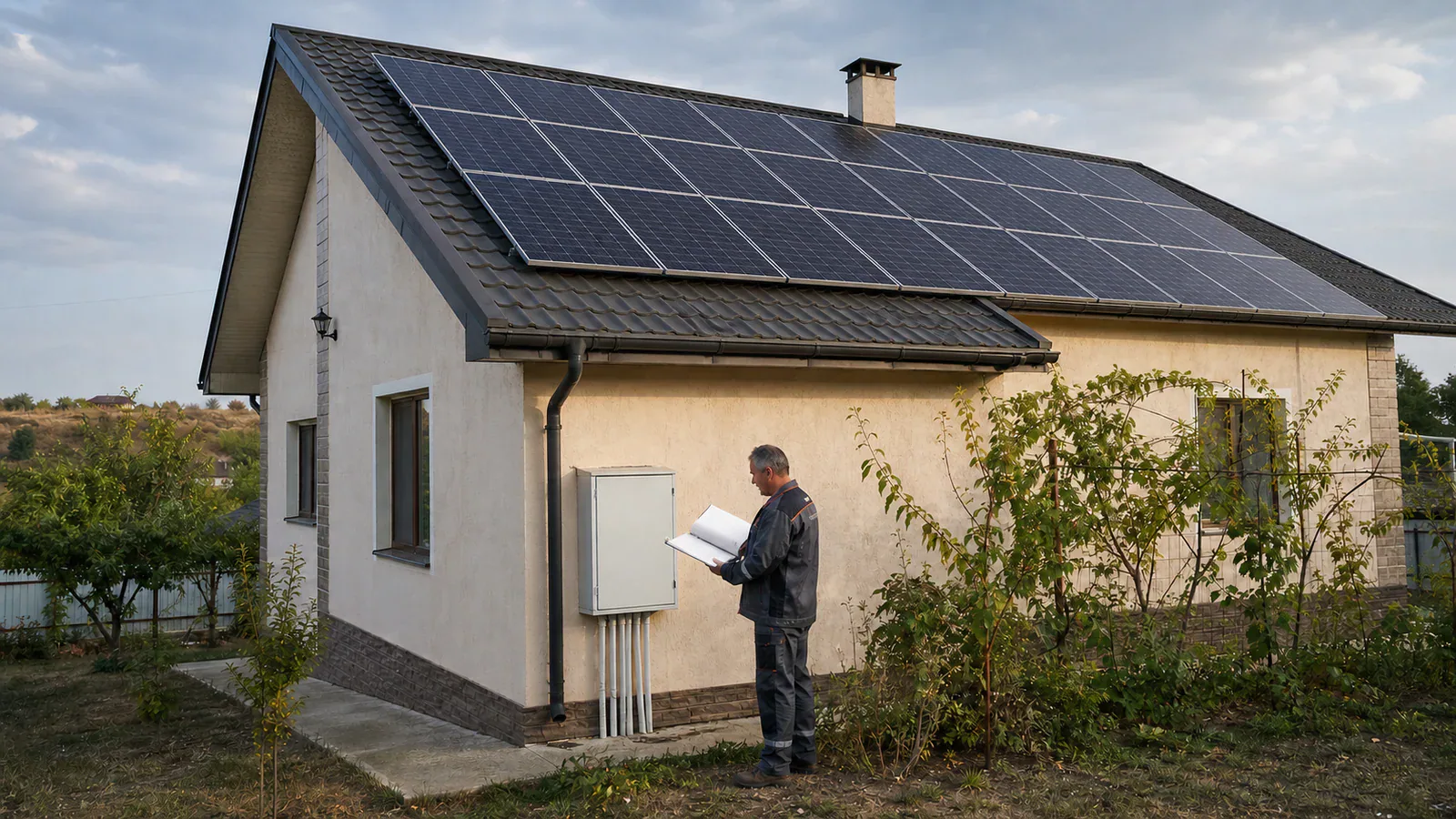
For an individual residential house, including a duplex or terraced house, the exemption covers photovoltaic panels and/or a heat pump together with the associated infrastructure. They may be placed on the roof, the façade and/or the related land, within the boundaries of privately owned land.
That boundary matters. If ground-mounted panels cross the cadastral boundary, occupy someone else’s land, a common-use strip or an area with a different legal regime, Article 150 does not cure the issue. The title and permitted use of the exact location must be established first.
For an apartment building, the law identifies the roof and façade but ties the exemption to the electricity supply of common-use areas. Typical examples are staircase and courtyard lighting, the lift, pumps or other common equipment. It is risky to treat this provision as ready-made permission to use the common roof solely for one flat: that project’s purpose would not match the published text.
For other types of buildings governed by the relevant legislation, panels and heat pumps may be placed on the roof or façade. This may include office, retail, manufacturing and agricultural buildings. A ground-mounted solar installation beside such a building, however, is not listed as expressly as the land attached to an individual home. Its construction status requires a separate assessment.
No building permit does not mean no project
Project documentation remains mandatory for works under the amended Article 150. Its scope depends on the building, and an equipment supplier should not replace it with the sales phrase “no permit required.”
The electrical section is prepared on the basis of the grid-connection approval issued by the system operator. The approval is issued to the owner or a holder of a right to use the property. Where the applicant is not the owner, the law provides for the owner’s written consent to issuance where applicable. The electrical solution is coordinated with the system operator.
The law also identifies a structural-resistance section. Where equipment is installed on the roof, load-bearing wall or façade of a building other than an individual house, this section must be based on a technical expert assessment. Those buildings also require an architectural section endorsed by the chief architect of the competent local public authority.
The technical designer needs more than the panel specification: the fastening layout, module and ballast weight, wind and snow loads, cable routes, inverter, protective equipment and emergency shutdown arrangement. Storage adds siting, ventilation and fire-protection issues. These are technical matters, but the contract should identify who commissions the expert assessment, who obtains endorsements and who is liable if the selected equipment does not match the connection conditions.
An acceptable file is not simply any document labelled “project.” Check each section required for the building and technical solution, as well as the authority of the professionals signing it.
Roof, façade and protected area: check rights and restrictions
The absence of a building permit does not create a new property right. A tenant, user or single co-owner cannot dispose of the roof, façade or land beyond the scope of their title and the owner’s consent.
In a condominium, the roof and façade are normally common parts. Before design begins, review Law No. 187/2022 on condominiums, the instrument establishing the condominium, the association’s articles, the owners’ register and the competence of the body adopting the resolution. The resolution should record the installation’s location and purpose, budget and funding, installer access, equipment ownership, maintenance, insurance and allocation of the electricity or savings.
Do not import a universal “two-thirds of votes is enough” rule from an old publication. Law No. 153 removed the former Article 37(2)(d), often cited in relation to contributions for common property. The required voting route must now be determined from the nature of the particular decision and the current law and condominium documents.
Cultural heritage requires a separate check. Work in a cultural-historical reserve, historic locality or monument protection zone requires a favourable opinion from the central cultural-heritage authority. Installing photovoltaic panels and associated infrastructure directly on an individual historic monument is prohibited.
Before signing the supply contract, obtain a current extract from the Real Estate Register and check not only the building owner but also the land’s cadastral number, restrictions and protection status. An ordinary-looking house is not proof that no special regime applies.
Check the property before ordering equipment
Colenco Legal can review rights to the roof or land, the building’s legal status, owners’ resolutions and the documents required for installation and connection.
Grid connection and net billing remain separate procedures
Article 150 simplifies construction control, not access to the electricity grid. The grid-connection approval sets the technical and economic conditions under which the specific installation may be connected. Designing and building the connection, inspection and energisation are governed by the electricity-grid connection rules and ANRE acts.
A safer sequence starts before buying the inverter and panels:
- establish the existing contracted capacity and planned generation capacity;
- apply to the relevant system operator for a connection approval or confirm that a simplified procedure applies;
- compare the issued conditions with the inverter, protection, metering and project;
- complete the work and commissioning procedure applicable to that installation category;
- separately formalise the relationship with the supplier if the applicant expects to use net billing.
Under net billing, electricity taken from and delivered to the grid is accounted for under the regulated mechanism and contractual terms. The physical production of electricity does not automatically confer prosumer status or guarantee payment for every unit of surplus at the price used in a seller’s commercial calculation. Law No. 10/2016 provides the framework, but eligibility, capacity limits and documents must be confirmed for the applicant.
If the seller promises a turnkey connection, the contract should identify the operator, the procedure, the included work and the consequences of a refusal or an approval with different parameters. Otherwise, the buyer retains the risk that the equipment will be incompatible.
Batteries and tax incentives: the rules do not transfer automatically
For storage, Law No. 153 added point q¹. It covers electricity-storage facilities and associated infrastructure located on the territory of photovoltaic parks or other existing or planned energy-infrastructure, commercial, agricultural or industrial facilities.
The project for those works includes a general site plan, electrical and automation sections, strength and stability, and fire protection. In a protected, sanitary-protection or other special zone, the site plan must be coordinated with the competent authority. The electrical part is again based on the connection approval and coordinated with the system operator.
An ordinary home battery is not expressly listed in q¹ as a standalone universal category. It may form part of a wider home-energy system, but the construction treatment depends on its location, installation method and relationship with other works. A seller’s statement that “batteries never need a permit now” is too broad.
Separately, Law No. 112/2026 introduced tax and customs measures for renewable-energy investments with storage. The Ministry of Energy described a zero customs rate for qualifying batteries and the possibility of VAT refunds for eligible VAT payers. This is not an automatic retail discount for every homeowner: check the commodity code, importer or buyer, VAT status, transaction and refund process before relying on it.
A safer sequence before paying for the equipment
Complete six steps before paying a non-refundable deposit:
- Confirm the property and right. Obtain a current extract, land plan and evidence of ownership or use.
- Classify the installation. A home, condominium, other building, ground-mounted plant and battery may follow different rules.
- Check restrictions. Establish the common-property status, required resolutions, and protected or sanitary zones.
- Obtain grid conditions. Align the connection approval and intended settlement mechanism with the capacity and equipment model.
- Fix the project scope. Allocate responsibility for the electrical, structural, architectural and fire-protection sections where required.
- Link payment to results. Provide for a refund or equipment replacement if the project, expert assessment or connection approval excludes the agreed configuration.
The supply contract should specify models and technical characteristics, design and endorsements, deadlines, acceptance, user training, equipment and workmanship warranties, maintenance, monitoring access and the response if connection proves impossible. The words “turnkey solution” without a list of deliverables are weaker than a detailed schedule.
The reform genuinely removes a demanding administrative step. Its benefit works only if the absence of a building permit is not confused with the absence of project documentation, property rights or electricity-grid rules.