
A company name, logo, domain, text, design and source code are protected through different legal mechanisms. Business registration does not replace a trademark, and paying a contractor does not always transfer every exclusive right to the customer.
Protecting a brand in Moldova: essential actions
- Inventory the name, logo, domains, content, designs and software code.
- Search the sign before launch and select the relevant goods and services.
- Distinguish company names, trademarks, copyright and domain registration.
- Document rights from employees, designers, photographers and developers in writing.
- When infringement occurs, preserve evidence first and choose a proportionate remedy.
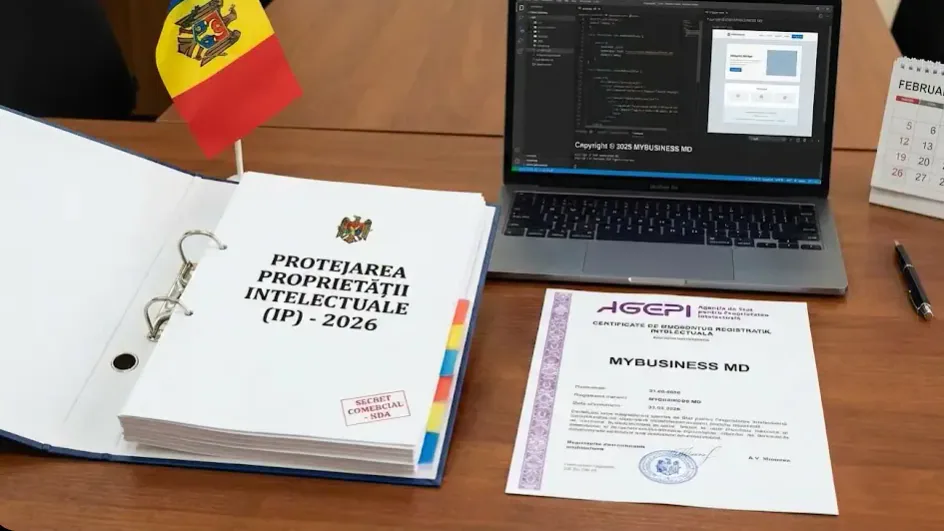
Why company registration does not fully protect a brand
A legal entity's name identifies the registered company but does not automatically provide the same exclusive scope as a registered trademark. A domain supplies a technical address, while a social account also depends on platform rules. These assets may use identical wording but rely on different legal grounds.
Create an asset map covering the word mark, logo, slogan, packaging, photographs, copy, video, interface, database, code, domains and accounts. For each item, record the creator, creation date, contract, file owner and territory of use. This register exposes gaps before major advertising expenditure.
For a new product, conduct the legal review before packaging is printed and a campaign scales. An early change is cheaper than a dispute, rebrand and loss of accumulated traffic.
Searching and registering a trademark with AGEPI
A clearance review looks beyond exact matches to similar signs for related goods and services. Searching reduces risk but does not guarantee registration: AGEPI examines absolute and relative grounds under the applicable rules. Descriptive, misleading or conflicting signs may face refusal or opposition.
An application concerns one mark and includes applicant details, the representation and a list of goods and services. Classes should reflect real and planned activity. A list that is too narrow leaves commercial directions uncovered, while a mechanically broad list increases expense without a useful protection strategy.
After filing, monitor AGEPI communications, response periods and publication. Registration is not the final task: manage renewals, ownership changes, licences and similar later applications. Plan national or international filing routes before expanding outside Moldova.
Need to review the documents and risks before the next step?
A lawyer can assess the contracts, correspondence and facts, identify vulnerable points and recommend a practical plan for the business.
Copyright in logos, text, photography and code
Copyright generally arises when an original work is created in an objective form, not only after registration. Existence of a right and proof of ownership are nevertheless different questions. Preserve source files, versions, dates, specifications, correspondence and handover records.
Buying a photograph, design or development service does not always transfer all exclusive economic rights. The contract should identify the work, permitted uses, territory, term, modification rights, remuneration and transfer point. The position of an employee may differ from that of an independent contractor.
Do not use images, fonts, music, templates or code simply because they are available online. Review the licence, commercial-use limits, attribution requirements and permission to modify. Retain a copy of the licence that applied when the asset was obtained.
Domains, social media and commercial contracts
Register key domains and accounts to the company or under its control, not to a former employee's or agency's personal email. Maintain an access register, enable additional security and define a transfer process when providers change.
A licence states who may use the mark or content, where and how, whether sublicensing is allowed and who controls quality. In franchising, distribution, white-label arrangements and joint advertising, brand rights should match the commercial obligations.
An NDA protects confidential information but does not replace an intellectual-property assignment. A non-compete clause likewise does not establish who owns the logo, database or software module.
What to do when a brand is copied
First preserve the infringement: page address, date, contextual screenshots, product, advertisement, seller details, a test purchase where appropriate and documents proving your own rights. A detached image without URL or date may be insufficient.
Then assess similarity, goods and services, territory, priority and actual confusion risk. In some cases a platform report or reasoned demand is enough; others require interim measures, an AGEPI procedure, customs action or litigation. The correct route depends on the asset and evidence.
Avoid mass accusations before validating the right. An unsupported demand can undermine negotiations and create counter-risk. The objective is to stop a specific infringement and preserve the brand's commercial value.
Practical IP checklist for a business
- Create a register of signs, works, domains and access rights.
- Clear the name before launch and select relevant classes.
- File the application and assign responsibility for AGEPI deadlines.
- Update employee and contractor agreements.
- Preserve source files, licences, handover records and version history.
- Monitor similar signs and copying of content.
- When infringement occurs, secure evidence before sending a demand.
A full audit is important before investment, franchising, a business sale, export or presenting technology to an investor. It tests not only registrations but the chain of title that determines whether an asset can be used, licensed and sold safely.
A short ownership audit before filing or enforcement
List each asset separately: word mark, logo, packaging, domain, photographs, copy, software and design files. For every item, record who created it, under which contract, whether exclusive rights were transferred in writing, where the source files are stored and which company actually uses it. Payment of an invoice alone should not be treated as a complete chain of title.
Before applying for a trademark, search similar signs and select the goods and services that match the real business plan. Before sending an infringement notice, preserve dated screenshots, URLs, invoices, repository history and the registrations or contracts proving ownership. This avoids demanding removal of material the company cannot yet prove it owns.