
A single registry extract does not show the whole picture. Before a deal or dispute, legal OSINT helps correlate open information about a company, its connections, litigation history and asset indicators, while separating verified facts from hypotheses.
OSINT before a deal: what to check first
- OSINT for business is a lawful analysis of open sources, not hacking, surveillance or buying closed databases.
- Before a major contract, payment deferral or share purchase, it is useful to check not only the company but also the connections around it.
- In debt recovery, OSINT can identify signs of assets, affiliated persons and the same business continuing through other structures.
- For court, the key issue is not an "interesting fact", but the source, date, method of fixation and link to the legal claim.
Business risk is often visible before the contract is signed. A counterparty has recently changed companies, works through connected persons, has court disputes, publicly shows assets, but the legal entity formally owns nothing. These signals are sometimes missed because the check is limited to a registry extract and a quick internet search.
Legal OSINT helps build a clearer picture before the problem becomes litigation. For Colenco Legal, it is part of legal work: counterparty due diligence, debt recovery in Moldova, corporate investigations, identifying signs of debtor assets and preparing materials for negotiations, claims or interim measures.
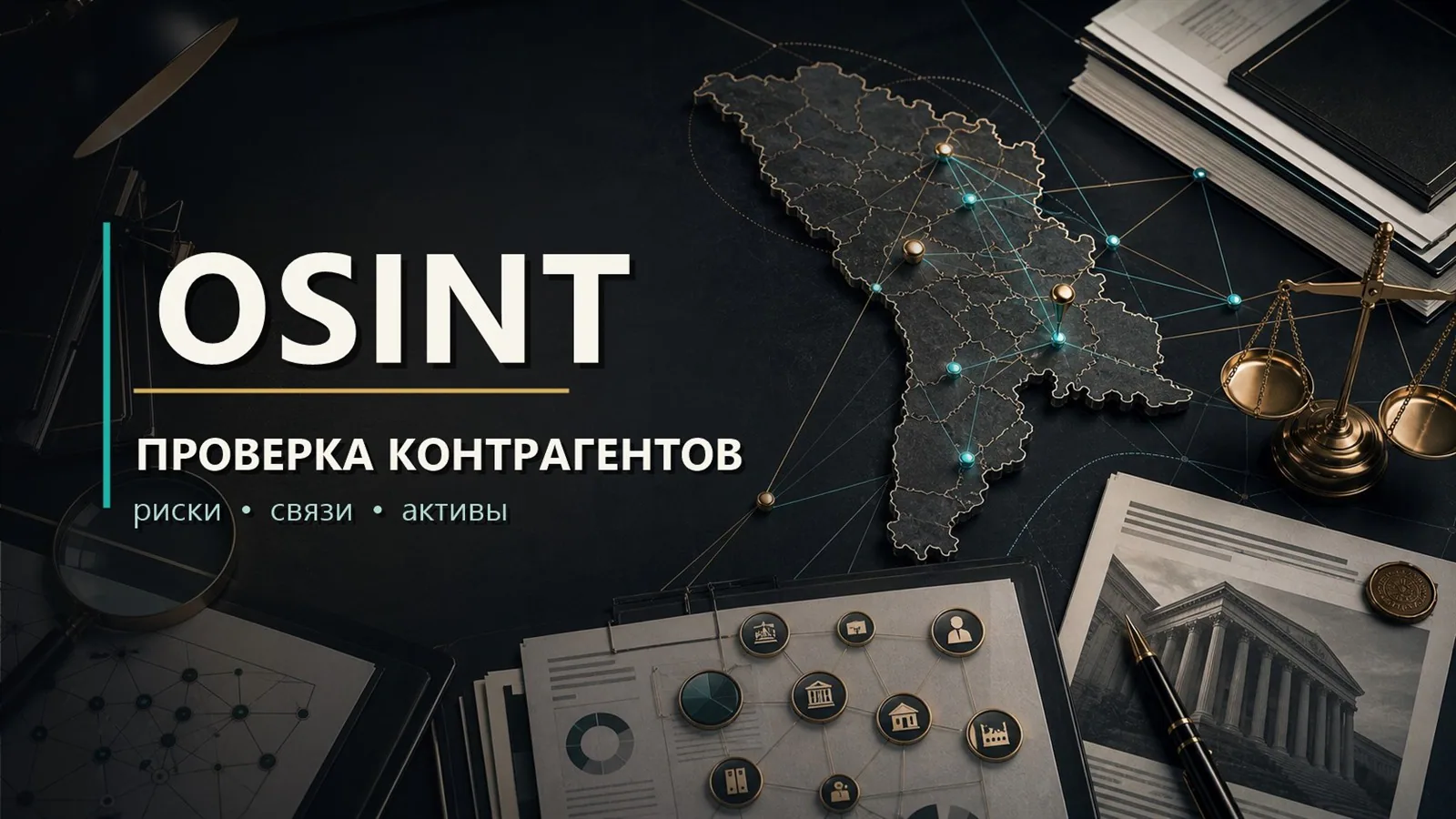
What legal OSINT means and where legality starts
In Moldova, the baseline review usually starts with ASP services for legal entities, information about beneficial owners, judicial resources, MTender, company websites and other lawfully available publications. Where personal data is involved, the purpose and scope of use should be assessed against the requirements and guidance of the CNPDCP.
The key word is "lawful". Legal OSINT does not mean illegal access to data, hacking, phishing, buying personal data, using leaks or interfering with private life. Such information is not useful for a legal position and may create separate risks for the client.
For a lawyer, verifiability matters more than sensational detail. If a source is open but includes personal data, it still needs to be used carefully: with a clear legal purpose, without excessive distribution and with regard to privacy. A counterparty check in Moldova should therefore be built as an analysis of a specific business risk, not as an investigation for its own sake.
In practical terms, there are three filters. First, the lawful purpose is defined: deal, debt, dispute, corporate conflict or compliance. Then the sources are selected so they can be explained and checked again. Finally, the information is fixed in a way that shows when it was obtained, where it came from and why it matters to the client's question.
When a business needs OSINT: deals, debts and corporate conflicts
OSINT is especially useful where the cost of a mistake is higher than the cost of a preliminary check. Before a major contract, for example, it is worth understanding who effectively stands behind the company, whether there are signs of conflict between participants, and whether several companies repeat the same addresses, websites, employees or beneficial owners.
Before granting payment deferral, a check helps assess whether the counterparty is taking on obligations while already under financial pressure. Before buying a share or a business, OSINT may reveal litigation history, dependence on one asset, the seller's connection with problematic companies or signs of a nominee director.
For transactions involving shares, assets, corporate rights or significant commercial obligations, OSINT should usually go together with legal document review. This is an area where open-source analysis is useful, but classic corporate law work is also needed: charter documents, administrator authority, restrictions on share transfers, participant approvals and company change history.
Debt recovery is a separate scenario. The company stops responding, formally has no assets, but the business may continue through another legal entity. In that situation, open-source analysis can help check whether the same addresses, websites, phone numbers, employees, vehicles, warehouse, real estate, contractors or public sales channels are being used. This does not guarantee finding property, but it helps form hypotheses for further legal steps.
OSINT is also useful in corporate conflicts, suspected asset transfers, foreign partner checks, preparing a claim, negotiations on debt repayment and before requests for interim measures. The purpose is the same in each case: reduce uncertainty before the decision becomes expensive.
Checking a counterparty before a deal?
We assess the objective, available sources and legal risks. During the first consultation, we determine what level of review is justified for your situation.
What can be established: connections, beneficiaries, litigation history and asset indicators
Open sources do not establish absolute truth; they help build a working risk map. It may include connected companies, current and former administrators, beneficial owners, repeated addresses, phone numbers, domains, websites, employees, trade names and public projects.
Litigation history shows with whom and over what issues the company or connected persons have disputed. This matters not only for reputation. Repeated debts, supplier disputes, conflicts between participants or debt recovery cases may show a pattern of behaviour.
Public procurement and tender data can sometimes show whether a company participated in state contracts, which contracting authorities it worked with and through which legal entities it appeared on the market. Websites, advertisements and domains may show the real business even when formal documents look empty.
When searching for debtor assets, wording must remain careful. It is correct to say that OSINT can identify signs of assets, signs of actual use of property, links between persons and directions for documentary verification. It is not correct to promise that OSINT always finds property or proves asset transfers.
A good result is not a long list of coincidences, but a clear map: which facts are confirmed, which remain hypotheses, what should be requested in documents and what conclusions cannot yet be drawn. This caution is especially important if the next step is a pre-claim letter, court action, interim measures or enforcement work.
Why legal OSINT is different from ordinary internet search
An ordinary internet search gives a set of links. Legal OSINT should provide structure: a chronology of events, a map of connections, a list of sources, an assessment of the legal meaning of facts and recommendations for next steps.
For example, the fact that two companies use the same address may prove nothing by itself. But if it is combined with the same website, the same employees, a company change before the debt arose, public continuation of the same business and overlapping beneficiaries, the picture changes. For a lawyer, this is no longer a set of random details but a possible line for checking affiliated persons, bad faith conduct or asset transfer.
The same rule applies in due diligence. An investor or share buyer should not rely only on a website and attractive public materials. It matters whether the public image matches the legal reality: who controls the business, whether there are disputes, whether revenue depends on one client, one asset or one person.
Not every piece of information found online automatically becomes court evidence. A legal position depends on the source, date, fixation method, relevance to the dispute and connection with the claim. Sometimes OSINT material is not standalone evidence but a guide: what documents to request, whom to involve in the dispute, which interim measures to seek and what negotiation position to take.
What the client receives and when to ask for help
After a legal OSINT analysis, the client may receive a short report, a connection map between companies and persons, a list of identified risks, sources, a chronology of events and recommendations for further steps. Depending on the task, these may be materials for due diligence, a pre-claim letter, court action, negotiations, interim measures or enforcement.
It is best to act before the risk becomes irreversible. Practical triggers are simple: the counterparty asks for payment deferral, the transaction value is significant, the partner recently changed companies, the debtor says there is "nothing to recover", the business is operating in fact but the legal entity is empty, there are signs of asset transfer, a foreign partner needs to be checked or litigation is being prepared.
The format depends on the task. Sometimes a short pre-contract check is enough. Sometimes a broader report is needed, with several layers of connections, a timeline and separate recommendations for negotiations, a claim, court or enforcement.
OSINT does not replace legal review of documents and does not guarantee that assets will be identified. Its value lies elsewhere: it helps spot inconsistencies earlier, formulate testable hypotheses and choose the next lawful step — additional due diligence, negotiations, a formal notice, court action or interim measures.