
A practical guide to the Moldovan discussion about taxing transfers from non-relatives: when a transfer may be income, what documents to keep and how to respond to SFS questions.
A transfer from a non-relative is not automatically taxable
- As of 18 June 2026, the issue is linked to consultations on Moldova's 2027 fiscal policy, not to a simple rule that every transfer from a non-relative is taxable.
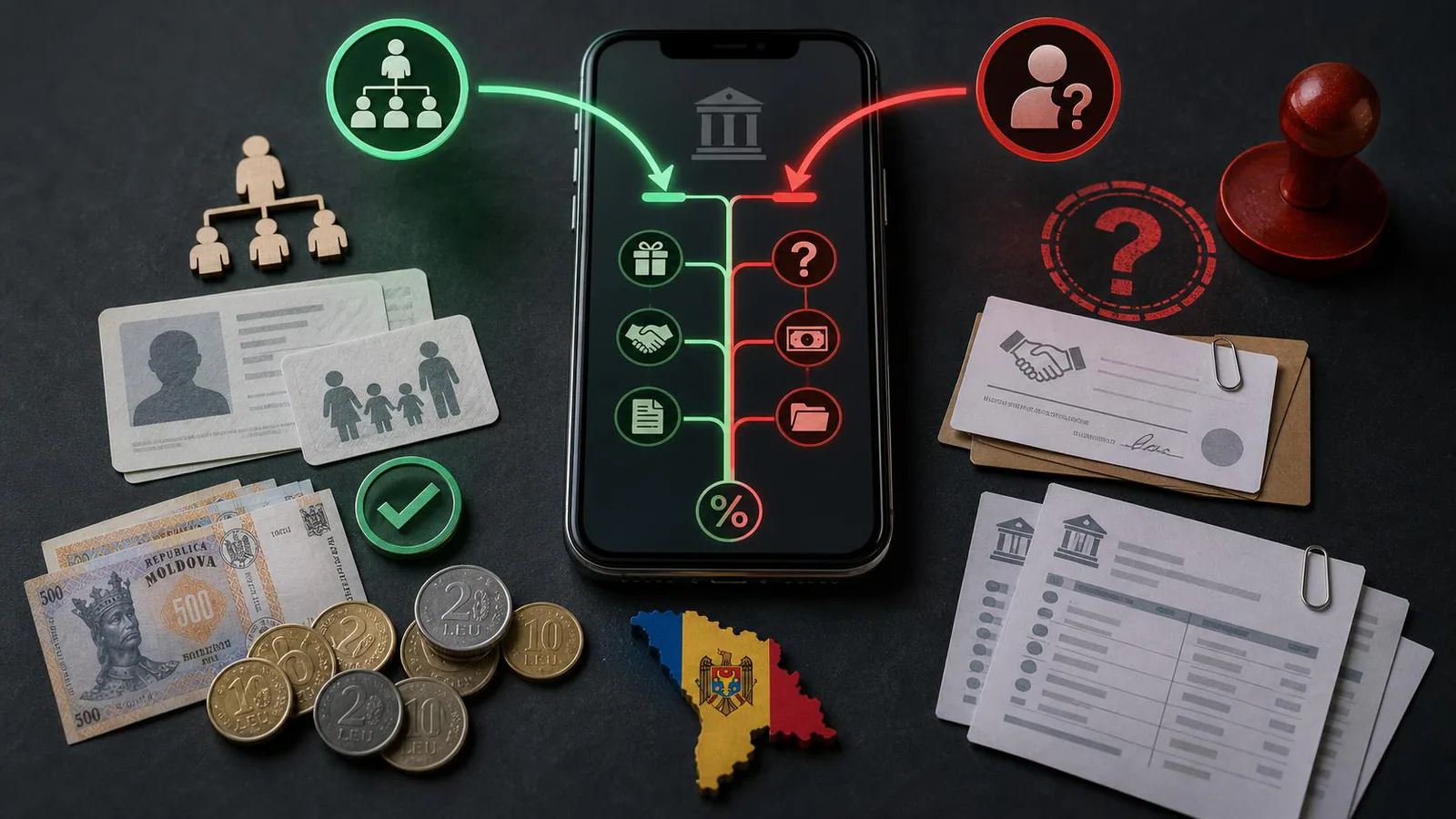
- The key question is not only who sent the money, but why it was sent: gift, loan, debt repayment, service fee, sale proceeds or family support.
- Larger, regular or commercially worded transfers require better documentation.
- The main mistake is trying to explain the money only after a bank or the State Tax Service asks questions.
The phrase "tax on transfers from non-relatives" sounds broad, but the legal issue is narrower. A bank transfer proves that money moved. It does not, by itself, prove taxable income.
What is known about the 2027 fiscal package
On 17 June 2026, Moldova's Ministry of Finance published a Q&A on the draft fiscal policy for 2027. That means the topic is in the consultation/draft stage, not a final rule already applied to all transfers.
The Q&A explains salary taxation, capital gains, VAT rates and replacing some personal allowances with direct payments. The visible Q&A does not set a final rule saying "transfer from a non-relative = tax".
Why the source of money matters
Tax risk appears when an incoming payment looks like income and the recipient cannot document a different reason. The same 20,000 MDL transfer may be service income, sale proceeds, loan repayment, a gift, family support or reimbursement of shared expenses.
Has the bank or SFS asked about transfers?
We assess the basis for the payments and the documents supporting the source of funds and their tax treatment.
Transfers that most often raise questions
Risk is higher when payments look like undeclared activity: regular transfers, many senders, commercial descriptions, large amounts without a clear relationship, or quick withdrawals and onward transfers.
Documents worth keeping in advance
- loan: agreement or written receipt;
- gift: clear payment description and correspondence;
- family support: proof of kinship;
- sale of property: sale agreement and price evidence;
- services or freelance work: contract, invoice and the right tax regime.
What freelancers and people with regular inflows should do
If the money is paid for work, it is safer to treat it as potential income and choose the correct legal and tax format in advance. Personal-card payments that repeat often may look like undeclared business.
A payment reference does not prove the transaction's legal nature. For each transfer identify the basis: loan repayment, gift, shared expenses, asset sale, payment for services or another obligation. Preserve the agreement, messages, receipt, invoice, relationship evidence where relevant and the money trail. The same amount can have a different tax result depending on the facts.
Where payments arrive regularly from different people, assess whether they amount to systematic activity. Do not split transfers or use third-party accounts to conceal their purpose. If a bank or the SFS requests an explanation, prepare a short chronology with primary records rather than creating documents retrospectively. For a large, foreign or mixed-purpose transfer, review tax classification before receiving the funds.
If SFS asks questions, respond with documents
- Make a table of inflows.
- Split payments into categories.
- Attach documents for each category.
- Do not call income a gift if there are signs of payment for services.
- For large or unclear amounts, get legal and tax advice before responding.
The practical question is whether you can prove why the money arrived and why it is not taxable income.